

Miti Desai
A contemplative performance inquiry by dancer and designer Miti Desai, marking a return to movement after a pause. Rooted in the classical language of Mohiniattam (a dance form from Kerala), the work does not seek continuity but re-entry, approaching the form as unfamiliar terrain. It engages with memory, resistance, vulnerability, and restraint, situating dance within the often-unseen spaces of stillness and recalibration. Here, pause is Generative Inactivity: a state of attentive listening where stillness and action continually nourish one another. Movement unfolds in dialogue with spatial awareness, where the design lens becomes an active presence.
Emerging from this threshold, the project questions inherited notions of virtuosity and outward spectacle, instead turning toward process, presence, and distilled intention. Drawing from the artist’s practices in both dance and design, the choreography pares classical vocabulary to its essence, reassessing form, function, and meaning. At its core, The RE:Moving Project treats the contested idea of tradition as a living, negotiable system anchored in lineage yet shaped by interruption and lived experience. Unfolding through three interlinked explorations: The Churning, The Temptress, and The Awakening. The work invokes the auspicious form of Lakshmi as a shifting energy of desire, illusion, abundance, and transformation, inviting the audience into cycles of stillness and motion where personal and cultural narratives quietly surface.
A movement and spatial design exploration grounded in, and re-imagined through, the vocabulary of Mohiniattam. A contemplative performance inquiry.
CREDITS:
Concept, Choreography & Performance: Miti Desai
Music Composition & Voice: Bindhumalini
Veena: Kadambhari Venkatraman
Percussion: Edakkya, Ganjira; Handsonic, Rhythm Programming - Arundas Sruthilaya
Music Editing, Mixing & Mastering: Sridhar Varadarajan
Jati Composition: Vinaya Narayanan
Lighting Design: Keerthi Kumar
Backdrop
Concept & Design: Miti Desai
Animation: Raj Shekhar
Promotional Photography: Arvind Sridhar
Production & Management: Alif
Rehearsal Venue Support: Shoonya Centre for Art and Somatic Practices
Reference & Inspiration: The Legend of the Goddess - Om Swami
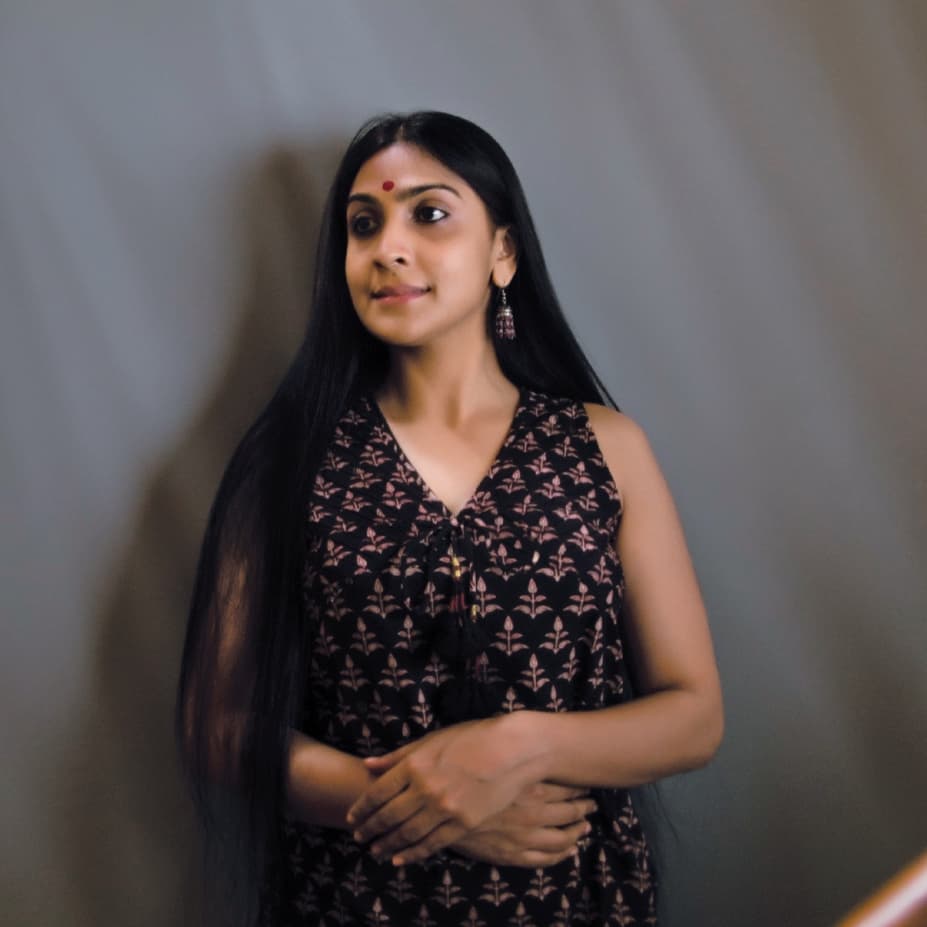
Miti Desai is a trained classical Indian dancer specialising in Mohiniattam, and a designer with years of rigorous traditional training. After more than a decade of performing as a soloist, she now approaches dance through a contemporary design lens; reimagining its formats, themes, and movement vocabulary to explore the unsettling and the unknown. Her artistic practice deconstructs and re-engages with tradition through a process-driven inquiry that navigates the tension between heritage and modernity. Dance and design are Miti’s intertwined creative languages, shaping how she engages with the world. With over two decades of experience as a designer, her choreographic approach is informed by a deep exploration of the essence, history, and purpose of design. She examines the intrinsic relationship between spirituality and aesthetics in classical Indian dance, reinterpreting its elements to balance form and function while remaining rooted in the traditional knowledge systems.
Miti Desai is a trained classical Indian dancer specialising in Mohiniattam, and a designer with years of rigorous traditional training. After more than a decade of performing as a soloist, she now approaches dance through a contemporary design lens; reimagining its formats, themes, and movement vocabulary to explore the unsettling and the unknown. Her artistic practice deconstructs and re-engages with tradition through a process-driven inquiry that navigates the tension between heritage and modernity. Dance and design are Miti’s intertwined creative languages, shaping how she engages with the world. With over two decades of experience as a designer, her choreographic approach is informed by a deep exploration of the essence, history, and purpose of design. She examines the intrinsic relationship between spirituality and aesthetics in classical Indian dance, reinterpreting its elements to balance form and function while remaining rooted in the traditional knowledge systems.
Masoom Parmar
All ages
All ages
Miti Desai is a trained classical Indian dancer specialising in Mohiniattam, and a designer with years of rigorous traditional training. After more than a decade of performing as a soloist, she now approaches dance through a contemporary design lens; reimagining its formats, themes, and movement vocabulary to explore the unsettling and the unknown. Her artistic practice deconstructs and re-engages with tradition through a process-driven inquiry that navigates the tension between heritage and modernity. Dance and design are Miti’s intertwined creative languages, shaping how she engages with the world. With over two decades of experience as a designer, her choreographic approach is informed by a deep exploration of the essence, history, and purpose of design. She examines the intrinsic relationship between spirituality and aesthetics in classical Indian dance, reinterpreting its elements to balance form and function while remaining rooted in the traditional knowledge systems.
Miti Desai is a trained classical Indian dancer specialising in Mohiniattam, and a designer with years of rigorous traditional training. After more than a decade of performing as a soloist, she now approaches dance through a contemporary design lens; reimagining its formats, themes, and movement vocabulary to explore the unsettling and the unknown. Her artistic practice deconstructs and re-engages with tradition through a process-driven inquiry that navigates the tension between heritage and modernity. Dance and design are Miti’s intertwined creative languages, shaping how she engages with the world. With over two decades of experience as a designer, her choreographic approach is informed by a deep exploration of the essence, history, and purpose of design. She examines the intrinsic relationship between spirituality and aesthetics in classical Indian dance, reinterpreting its elements to balance form and function while remaining rooted in the traditional knowledge systems.
Masoom Parmar